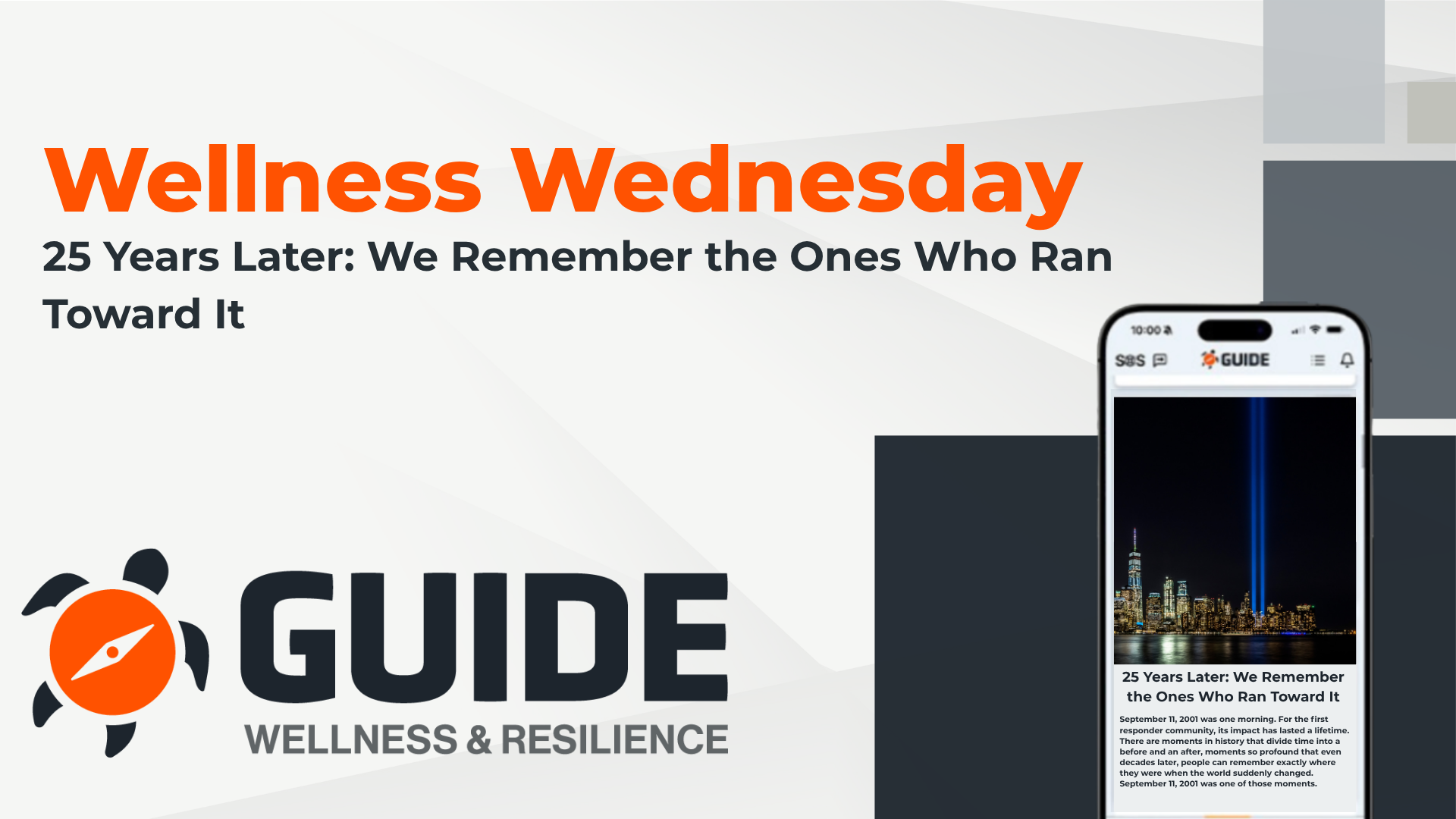
September 11, 2001, was one morning. For the first responder community, its impact has lasted a lifetime.
There are moments in history that divide time into a before and an after, moments so profound that even decades later, people can remember exactly where they were when the world suddenly changed. September 11, 2001 was one of those moments.
Twenty-five years later, the images remain almost impossible to separate from the memory of that day. A brilliant blue September sky disappearing behind smoke. Sirens echoing through streets filled with confusion. Strangers helping strangers. Faces covered in ash and dust. Families desperately searching for the people they loved. Photographs taped to walls, fences, and light poles in the hope that someone, somewhere, had seen them.
And moving through those images were the first responders.
Firefighters carried equipment toward buildings where thousands of people were desperately trying to escape. Police officers directed people toward safety while placing themselves closer to danger. Paramedics and EMTs prepared to care for an unimaginable number of injured people without knowing what the next several minutes would bring. Dispatchers remained on the other end of desperate phone calls, becoming a voice of calm for people experiencing the most terrifying moments of their lives.
They did what first responders have always done. When people needed help, they answered. When the world was running away from danger, they ran toward it.
On the 25th anniversary of September 11, we remember the nearly 3,000 people whose lives were taken that day. We remember the firefighters, police officers, emergency medical personnel, rescue workers, and countless others who went to work that morning without knowing that their ordinary shift would become part of history. But remembrance cannot stop at numbers, statistics, uniforms, or names carved into stone, because every number represented an entire human life.
Every uniform belonged to someone’s partner, parent, child, sibling, friend, neighbor, or coworker. Every person lost left an empty chair somewhere. Every name on a memorial represents birthdays that continued without them, holidays that never felt quite the same, children who grew older, spouses who learned to navigate a life they never expected to live alone, and colleagues who spent years remembering the person who once stood beside them.
Behind every name is a life that mattered. Behind many of those names are people who have spent the last 25 years learning how to carry the absence.
Some Calls Never Completely End
First responders are trained to keep moving. Finish the call. Clear the scene. Complete the report. Reset the equipment. Get back in service. Answer the next radio transmission. There is rarely enough time to fully process what just happened because somewhere else, another person is already having the worst day of their life and needs someone to show up.
That ability to continue functioning in the middle of chaos is one of the extraordinary qualities of the first responder profession. But continuing forward and leaving an experience behind are not always the same thing. The scene may clear. The shift may end. The uniform may come off. The call itself may be officially closed. Yet sometimes the experience stays.
Some calls follow people home.
They can return when the station becomes quiet enough for the mind to wander. They can appear in dreams, in the middle of dinner, while driving home from work, or years later when a particular smell, sound, street, anniversary, news story, or radio tone suddenly brings back something the mind never completely put away. Sometimes the memories that are easiest to suppress during the chaos of the moment become the hardest to understand once everything becomes quiet.
September 11 reminds us of this reality in a way few events can.
There were responders who walked out of the towers but watched friends and colleagues never come out. There were people who spent days, weeks, and months searching through debris because leaving before the work was finished did not feel like an option. There were responders who breathed the air at Ground Zero while concentrating on the mission in front of them, only to discover years later that the physical consequences of their service had followed them home.
Others carried wounds that no scan, blood test, or X-ray could reveal.
Trauma does not always arrive immediately after the traumatic event. Sometimes survival comes first. Sometimes the mind does exactly what it needs to do to get someone through the call, the shift, the deployment, the rescue, or the recovery operation. The processing may not begin until much later, when life becomes quiet enough for everything that was pushed aside to finally demand attention.
That is one of the most important lessons we can carry forward 25 years later: the emergency may end long before its impact does.
The People Who Came Home Carried Something Too
When we speak about sacrifice in the first responder community, we understandably speak about those who never came home. Their names deserve to be spoken. Their stories deserve to be told. Their service deserves to be remembered by generations that were not even alive when September 11 happened.
But remembrance must also make room for the people who did come home.
Coming home does not always mean leaving the experience behind.
Imagine walking back through your own front door after witnessing something no human being should ever have to witness and somehow being expected to become the same person who left that morning. Imagine sitting at the dinner table, helping your children with homework, asking your spouse about their day, laughing at a television show, brushing your teeth, turning off the bedroom light, and trying to sleep while your mind is still somewhere else entirely. Then imagine waking up and putting the uniform back on because another shift is waiting.
For generations, public safety culture often rewarded the ability to compartmentalize. Stay strong. Handle it. Keep moving. Do not let anyone see that something got to you. That mentality helped countless responders function during moments when emotion had to temporarily take a back seat to responsibility. It helped people survive circumstances most people will never experience.
But for some, surviving the moment eventually became carrying the moment alone.
Today, we understand far more about trauma, cumulative stress, post-traumatic stress, moral injury, grief, burnout, sleep disruption, depression, anxiety, hypervigilance, and the physical consequences of chronic stress than we did 25 years ago. That knowledge gives us an opportunity, but it also gives us a responsibility.
We cannot wait until someone reaches their breaking point before deciding their wellness matters.
Support should not begin at the crisis. It should exist long before one.
There Is a Human Being Under the Uniform
A uniform can create the illusion of invincibility. It represents training, authority, responsibility, courage, and the expectation that when everyone else is overwhelmed, the person wearing it will know what to do.
But underneath every uniform is still a human being.
A firefighter can carry someone out of a burning building and still be haunted by the person they could not reach. A police officer can remain composed through violence and chaos and later sit silently in their patrol car trying to understand why that particular call feels different. A paramedic can save hundreds of lives over the course of a career and still remember the face of one patient they could not save. A dispatcher can guide a stranger through the worst minutes of their life, disconnect the call, take one breath, and immediately answer the next ringing phone.
A corrections officer can spend an entire shift constantly evaluating their surroundings for danger and then struggle to turn that vigilance off when they walk through their own front door. A military member can return home from deployment while realizing that part of their mind still feels thousands of miles away.
These realities do not erase strength. They reveal the complexity of it.
Strength and struggle can exist inside the same person. Courage and grief can occupy the same space. Someone can love their profession deeply and still admit that sometimes the profession hurts them.
Being affected by difficult work does not mean someone is incapable of doing it. It means they are human enough to feel the weight of what they have been asked to witness.
When “I’m Fine” Means Something More
There are phrases heard so often in public safety that they can almost become automatic.
“I’m good.”
“I’m fine.”
“Just tired.”
Sometimes those words mean exactly what they say. Other times they are a shield covering something much harder to explain.
They can mean, I don’t know how to describe what I’m feeling without sounding weak. They can mean, Other people have experienced worse, so I don’t feel like I have the right to struggle with this. They can mean, I don’t want my family worrying about me. They can mean, I don’t want anyone at work questioning whether I can still do my job. They can mean, If I start talking about this, I’m afraid I won’t know how to stop.
And sometimes “I’m fine” simply means I need to survive the next shift.
That is why connection inside first responder communities matters so deeply. Wellness does not always begin in a clinician’s office or during a formal intervention. Sometimes it begins in the apparatus bay after everyone else has left. Sometimes it happens sitting in a patrol car, leaning against an ambulance, inside a communications center, around the station kitchen table, or in a text message sent after a difficult call.
It begins when someone pays enough attention to notice that something has changed.
“You’ve been quieter lately.”
“That was a rough one.”
“You haven’t seemed like yourself.”
“How are you really doing?”
Those questions may sound small, but to someone who has spent weeks, months, or years convincing everyone around them that they are fine, being genuinely seen can be powerful.
Sometimes caring for someone means believing them when they say they are okay. Sometimes it means knowing them well enough to ask one more time.
September Carries Different Memories for Everyone
For some first responders, September 11 is not history. It is personal.
They were there. They knew someone who was there. They lost a friend, coworker, family member, or mentor. They responded in the hours and days afterward. They worked at Ground Zero. They became sick years later. They watched people they served beside become sick. For them, the anniversary can carry memories that the rest of the country may only encounter through documentaries, photographs, ceremonies, and news coverage.
For others, September 11 became the reason they chose public service in the first place. A child who watched firefighters climbing toward danger in 2001 may be a fire captain today. A teenager who watched police officers helping strangers through the streets of Manhattan may now wear a badge. Someone who watched paramedics working under unimaginable circumstances may now climb into an ambulance every shift because they wanted their career to mean something.
And now there is an entire generation of first responders who were too young to remember September 11 or had not yet been born.
They did not witness that morning, but they inherited its legacy.
They serve in departments transformed by what happened. They train according to lessons learned from it. They work beside men and women whose careers were shaped by it. They entered professions whose culture, preparation, expectations, and understanding of large-scale emergencies were permanently changed by that day.
That is why remembrance still matters 25 years later. We do not remember because we want to remain trapped inside tragedy. We remember because understanding where we have been helps determine what we choose to carry forward.
Taking Care of Yourself Does Not Mean Turning Away From the Mission
There is something deeply admirable about choosing a profession built around serving other people. First responders routinely place another person’s emergency ahead of their own comfort, fear, exhaustion, and plans. It is part of what makes these professions extraordinary.
But service should never require someone to slowly disappear inside the role.
There is a dangerous difference between sacrifice and self-destruction. You should not have to completely empty yourself to prove that you care about the mission. You should not have to wait until exhaustion becomes burnout, stress becomes illness, grief becomes isolation, or a difficult season becomes a crisis before deciding you deserve support.
Sleep matters because the person responding at 3:00 a.m. matters. Nutrition matters because the body carrying the equipment matters. Movement matters because chronic stress lives in the body as much as it does in the mind. Relationships matter because people need somewhere they can exist without being defined by the uniform. Peer support matters because sometimes the only person who truly understands a difficult call is someone who has answered one themselves. Professional support matters because there are burdens that should not have to be carried without help.
Sometimes wellness looks remarkably ordinary. Five quiet minutes after a difficult call. Eating something before another long shift. Calling someone instead of sitting alone. Getting enough sleep when the opportunity exists. Recognizing that your patience has been shorter lately. Noticing that you are withdrawing from people you love. Admitting that something is following you home.
Wellness should not begin when someone finally falls apart.
The goal is not to make first responders unaffected by tragedy, because that would require removing part of what makes them human. The goal is to create a culture where responders have the resources, relationships, practices, and permission necessary to process what the profession asks them to carry.
Resilience is not the absence of impact.
It is having somewhere to turn when the impact becomes heavy.
Never Forget the Families
When we remember September 11, there is another group whose sacrifice deserves space in the conversation: the families standing behind those who serve.
First responder families understand something that can be difficult to explain to people outside these professions. Every ordinary goodbye before a shift carries a small amount of uncertainty. Most shifts end normally. Most goodbyes are followed by another hello. But somewhere in the background exists the understanding that when the person you love goes to work, their job requires them to move toward situations most people are trying desperately to escape.
Spouses learn to recognize the difference between ordinary exhaustion and the silence that follows a difficult call. Parents watch their children choose professions that require courage they are simultaneously proud of and frightened by. Children learn that Mom or Dad may miss dinner, a birthday, a holiday, or bedtime because somewhere another family is experiencing an emergency.
On September 11, hundreds of first responder families experienced the nightmare every public safety family knows is possible but hopes will never become their reality.
Twenty-five years later, those families remain part of this story.
Supporting first responder wellness means recognizing that the impact of this profession rarely stops with the individual wearing the uniform. Stress can enter the home. Grief can enter relationships. Hypervigilance can follow someone through the front door. Exhaustion can change how someone communicates with the people closest to them.
When we care for first responders, we strengthen the families standing beside them too.
“Never Forget” Must Be More Than Something We Say
Every September, two words appear across memorials, firehouses, police departments, ambulances, communications centers, social media posts, flags, and ceremonies across the country.
Never Forget.
Twenty-five years later, perhaps we should ask ourselves what that promise truly requires.
It means remembering the people whose names are carved into memorials. It means continuing to tell their stories long after the generation that personally remembers September 11 is gone. It means honoring the firefighters who climbed, the officers who ran toward chaos, the paramedics and EMTs who treated the injured, the dispatchers who answered desperate calls, the rescue workers who searched, and all those whose service in the years that followed was shaped by that day.
But perhaps “Never Forget” must also mean never forgetting the people who are still here.
The responder who has spent two decades carrying a call they have never discussed. The firefighter quietly living with an illness connected to their service. The police officer who has attended more funerals than anyone should have to attend. The paramedic who remembers one patient’s face despite treating thousands. The dispatcher who can still hear one particular caller’s voice. The veteran whose life was permanently shaped by what followed September 11. The new recruit who is only beginning to understand what this career may eventually ask them to carry.
Remembering the fallen and caring for the living should never be treated as separate missions.
They are part of the same promise.
To Every First Responder Reading This
You may spend your career becoming the person other people depend on during the worst moments of their lives. Over time, you may become exceptionally good at carrying things that are heavy, both literally and emotionally. Equipment. Responsibility. Expectations. Other people’s fear. Other people’s grief. Other people’s emergencies.
You may become so accustomed to carrying weight that you stop noticing how much of it you have accumulated.
But being strong enough to carry something does not mean you are required to carry it forever.
Check on your crew, but allow your crew to check on you too. Talk to your partner. Call the friend you have been meaning to call. Sit with your family without feeling guilty for being unavailable to everyone else for a little while. Take care of the body that carries you through every shift. Pay attention when your sleep changes, when your patience disappears, when things you once enjoyed stop feeling enjoyable, or when something inside you simply feels different.
And when someone you trust asks how you are doing, consider giving them the real answer.
You spend your career protecting strangers you may never see again.
The person underneath your uniform deserves protection too.
Twenty-Five Years Later
On September 11, 2001, first responders showed the world what service looks like in its most extraordinary and devastating form. They climbed when others descended. They entered when others escaped. They stayed when leaving would have been easier.
Some gave everything.
Others returned home carrying memories, injuries, illnesses, grief, and experiences that would follow them for decades. Their sacrifice did not end when the smoke cleared, and our responsibility to remember them should not end when September 11 passes on the calendar.
Twenty-five years later, we owe them more than a moment of silence.
We owe the fallen remembrance. We owe their families gratitude. We owe the survivors continued support. We owe the responders who became sick years later recognition of the price they continued to pay. And we owe today’s first responder community something previous generations did not always receive: a culture willing to recognize that caring for the people who serve is not separate from the mission.
It is part of the mission.
At The GUIDE App, that belief sits at the heart of what we do. Wellness is not separate from service. It is one of the things that makes a lifetime of service sustainable. Resilience does not mean pretending difficult moments do not hurt. It means building the practices, connections, resources, and support that allow people to carry what they have experienced without allowing those experiences to consume who they are.
This September, we remember every life lost on September 11.
We remember every responder who answered the call, every person who searched through the rubble, every survivor who walked away carrying memories few people could understand, every responder whose body later carried the physical consequences of that service, and every family that learned how long one terrible morning could echo through a lifetime.
But remembrance also asks something of us today.
It asks us to look around our own stations, departments, agencies, communications centers, crews, families, and communities and notice the people who are still carrying something.
It asks us to make it easier to say, “I’m struggling.”
It asks us to listen when someone finally does.
It asks us to create a first responder culture where seeking support is treated with the same respect as offering it.
Because perhaps one of the greatest ways we can honor the first responders of September 11 is to take better care of the first responders who continue answering the call today.
Twenty-five years later, we still remember those who ran toward danger.
We honor those who never came home.
We stand beside those who did.
And we will never forget.