Every shift presents uncertainty.
One moment you’re completing paperwork, and the next you’re responding to a life-threatening emergency. Whether you’re a police officer making a split-second decision, a firefighter entering a burning structure, an EMS provider treating a critical patient, or a 911 telecommunicator coordinating chaos from behind the headset, your performance during those moments matters.
But peak performance isn’t created in the middle of a crisis.
It’s built long before the call ever comes.
The strongest performers don’t simply react well under pressure—they prepare themselves mentally, physically, and emotionally every single day. Readiness is more than tactical training. It is the foundation that allows first responders to think clearly, communicate effectively, and make sound decisions when seconds matter.
Mental Preparedness Is a Daily Practice
Physical fitness has always been part of first responder culture.
Mental fitness deserves the same attention.
Mental preparedness means developing habits that allow you to stay focused, regulate emotions, and recover from stress before it begins affecting performance. Just as muscles require consistent training, cognitive performance requires regular maintenance.
Mental readiness includes:
- Managing stress before it accumulates
- Developing emotional awareness
- Building resilience after difficult calls
- Practicing mindfulness and controlled breathing
- Learning healthy recovery strategies
High performers understand that resilience isn’t something you discover during an emergency.
It’s something you build every day.
The Hidden Cost of Decision Fatigue
A first responder may make hundreds of decisions during a single shift.
Some are routine.
Others carry life-or-death consequences.
Each decision requires mental energy.
Over time, that mental energy becomes depleted, a phenomenon known as decision fatigue.
Decision fatigue can lead to:
- Slower reaction times
- Reduced attention to detail
- Increased frustration
- Impulsive decision-making
- Poor communication
- Difficulty prioritizing tasks
It’s often invisible until performance begins to decline.
Organizations frequently focus on improving tactical skills while overlooking the cognitive demands placed on their personnel. Helping first responders reduce unnecessary mental overload can preserve the mental capacity needed when critical incidents occur.
Sleep Is a Performance Tool
Many first responders accept fatigue as part of the profession.
Shift work, overnight calls, mandatory overtime, and unpredictable schedules often make quality sleep difficult.
However, inadequate sleep affects nearly every aspect of performance.
Poor sleep has been associated with:
- Slower reaction time
- Decreased situational awareness
- Reduced memory
- Lower emotional regulation
- Increased risk of injury
- Poorer decision-making
Sleep isn’t simply about feeling rested.
It’s one of the most important operational readiness tools available.
While perfect sleep schedules aren’t always realistic, improving sleep quality whenever possible can have a measurable impact on performance both on and off duty.
Situational Awareness Begins With Personal Awareness
Situational awareness isn’t only about recognizing external threats.
It also requires recognizing what’s happening internally.
Stress, exhaustion, frustration, and emotional overload can quietly narrow attention and reduce the ability to process information effectively.
When leaders encourage wellness conversations, they help normalize self-awareness.
Recognizing:
- elevated stress,
- declining focus,
- emotional exhaustion,
- or cognitive overload
isn’t a weakness.
It’s professional awareness.
Personnel who understand their own mental state are often better equipped to recognize risks before they become mistakes.
Maintaining Focus Under Pressure
During high-stress incidents, the brain naturally shifts into survival mode.
Heart rate increases.
Adrenaline rises.
Fine motor skills decrease.
Vision and hearing can narrow.
Without preparation, these physiological changes can negatively affect performance.
Evidence-based techniques such as:
- Tactical breathing
- Grounding exercises
- Mental rehearsal
- Visualization
- Controlled self-talk
can help first responders maintain focus and improve cognitive performance in stressful situations.
These aren’t wellness trends.
They’re performance tools.
Performance Optimization Is About Consistency
Elite athletes don’t wait until game day to prepare.
Military special operations teams don’t begin training during deployment.
First responders deserve the same performance mindset.
Optimization comes from consistently practicing habits that improve readiness, including:
- Regular physical activity
- Quality sleep
- Proper hydration
- Balanced nutrition
- Stress management
- Recovery after critical incidents
- Strong peer support
- Access to mental health resources
Small daily habits often create significant long-term improvements.
Readiness Habits That Make a Difference
Performance is built through repetition.
Consider incorporating habits like:
- Starting each shift with a quick mental reset
- Checking in with teammates throughout the day
- Taking brief recovery breaks after difficult calls
- Prioritizing hydration and nutrition
- Limiting unnecessary distractions
- Reflecting after each shift on lessons learned
- Asking for support before stress becomes burnout
Readiness isn’t about perfection.
It’s about consistency.
When Readiness Becomes Burnout
Even the most dedicated first responders can reach a point where stress exceeds recovery.
Burnout rarely happens overnight.
It develops gradually through repeated exposure to chronic stress, emotional exhaustion, organizational pressures, moral injury, and cumulative trauma.
Signs of burnout may include:
- Constant fatigue
- Loss of motivation
- Increased cynicism
- Difficulty concentrating
- Emotional detachment
- Decreased job satisfaction
- Feeling disconnected from family, coworkers, or the mission
The encouraging news is that burnout is not an inevitable outcome of serving others.
With the right tools, leadership support, and organizational culture, agencies can strengthen resilience while helping personnel remain healthy throughout their careers.
Join Our Upcoming Webinar
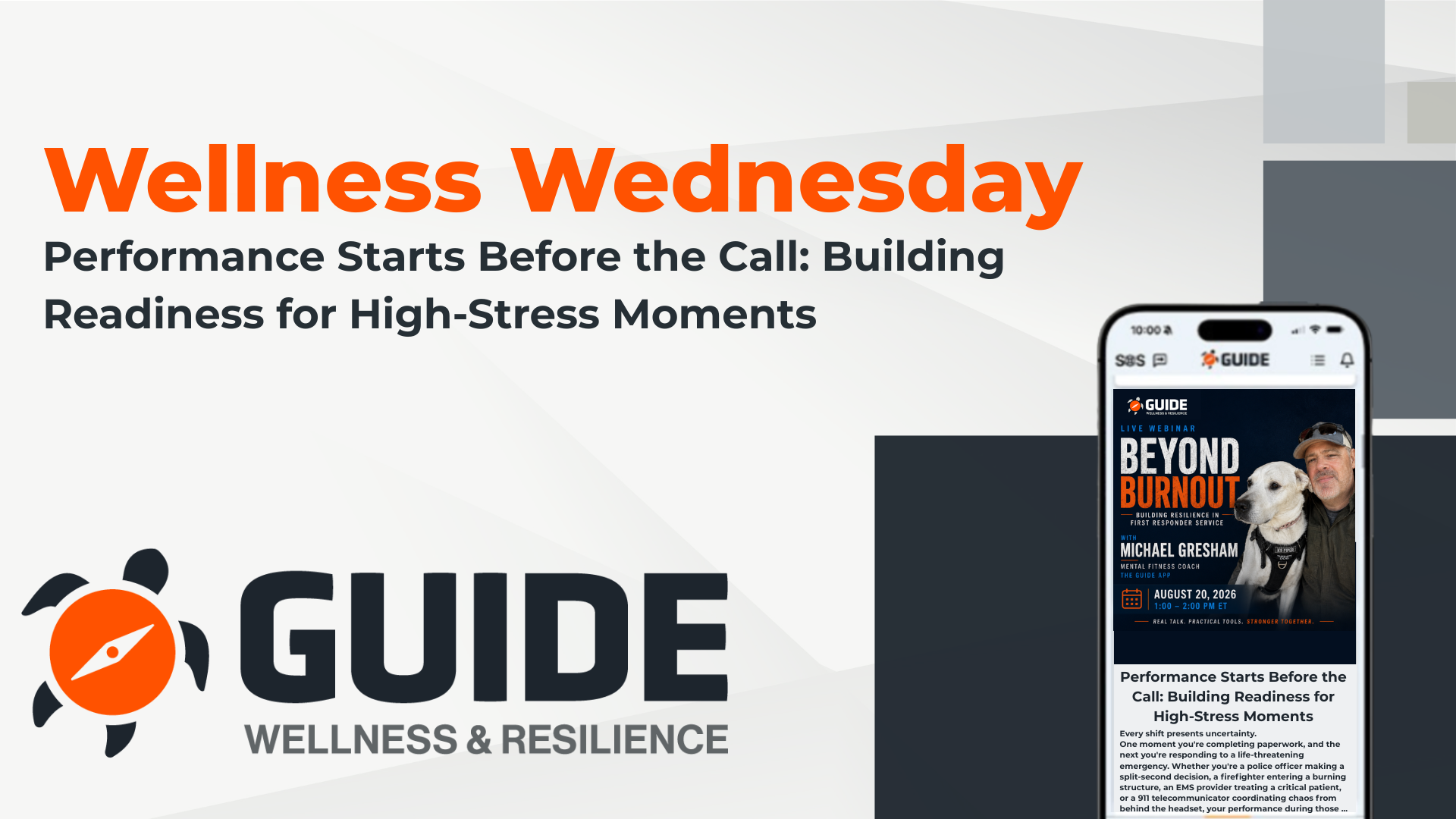
To continue this important conversation, The GUIDE App is proud to welcome Michael Gresham, nationally recognized Chief Wellness Officer and first responder wellness expert, for our upcoming leadership webinar:
Beyond Burnout: Building Resilience in First Responder Service
📅 August 20, 2026
🕐 1:00–2:00 PM Eastern
During this webinar, Michael will explore:
- The difference between stress and burnout
- Moral injury and institutional betrayal
- Why organizational culture matters
- Practical resilience strategies for individuals and agencies
- Leadership behaviors that improve psychological safety
- Actionable tools leaders can immediately implement to support their teams better
Whether you’re a police chief, fire chief, EMS director, communications supervisor, wellness coordinator, or frontline leader, you’ll leave with practical strategies to strengthen your people before burnout takes hold.
Because protecting those who protect others begins long before the next emergency.
Performance starts with readiness.
And readiness starts today.