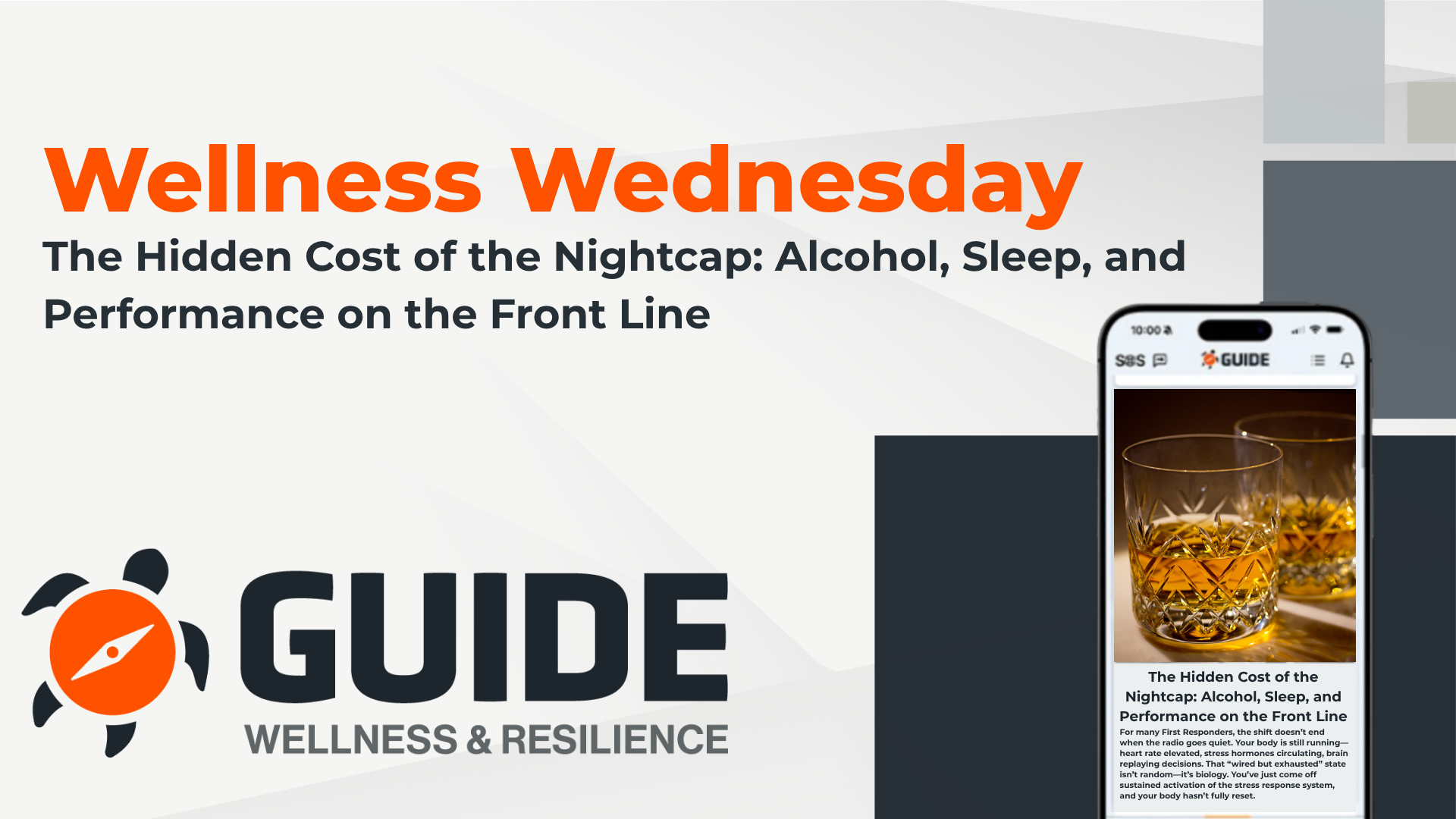
For many First Responders, the shift does not end when the radio goes quiet. Even after a call is complete, the body often remains in a state of activation. Heart rate may still be elevated, stress hormones continue circulating, and the brain replays decisions made during the shift. This “wired but exhausted” feeling is not random. It is a physiological response to sustained activation of the body’s stress systems.
Following prolonged exposure to high-stress situations, the sympathetic nervous system remains active. Cortisol and adrenaline levels stay elevated, leaving the body struggling to return to baseline. For many First Responders, alcohol becomes a common method of managing this transition.
In the short term, alcohol can feel effective. It can create a sense of calm, reduce feelings of hyperarousal, and help individuals fall asleep faster. However, while alcohol may create the appearance of recovery, it often interferes with the body’s actual recovery process.
Alcohol vs. Recovery: What’s Actually Happening
Alcohol can make you feel calmer after a stressful shift because it slows down activity in the brain. That is why many people feel like it helps them relax or fall asleep faster.
But recovery is not just about falling asleep quickly.
Real recovery depends on the quality of your sleep, how well your brain and body reset overnight, and whether you can fully recover from the stress of the day.
Research shows that alcohol:
- Suppresses REM sleep, which is critical for emotional processing and memory consolidation
- Leads to fragmented sleep as it metabolizes through the night
- Disrupts overall sleep architecture, even when total sleep time appears normal
(He, Hasler, & Chakravorty, 2019; Roehrs & Roth, 2001)
As a result, individuals may fall asleep more quickly but wake up feeling less restored. Over time, this can create a cycle of chronic fatigue, increased stress, and declining performance.
Why Alcohol Feels Effective
There’s a reason alcohol becomes a go-to.
There is a physiological reason alcohol becomes a common coping mechanism after exposure to repeated stress. High-stress situations increase cortisol production. Studies have shown that individuals with elevated stress responses often experience stronger perceived relief from alcohol, reinforcing the behavior and increasing the likelihood of repeated use (Stephens & Wand, 2012).
This creates a cycle in which high stress leads to stronger perceived benefits from alcohol, alcohol disrupts recovery, and poor recovery results in even greater stress levels the following day. Over time, this cycle does not reduce stress. Instead, it amplifies it.
The Cognitive Demands of Emergency Response
A 911 response places significant demands on both the brain and body. First Responders must process incomplete information, anticipate multiple possible outcomes, communicate effectively, and make rapid decisions in high-pressure situations.
At the same time, the body enters a heightened state of sympathetic activation. Cortisol and adrenaline increase, heart rate rises, and attention narrows. These responses are adaptive in the short term because they allow individuals to perform under pressure.
However, these systems were designed for brief periods of activation. Repeated exposure without adequate recovery can lead to cumulative stress, cognitive fatigue, and emotional exhaustion.
Decision-Making and the Prefrontal Cortex
Making good decisions under pressure depends on the part of the brain responsible for judgment, planning, staying calm, and thinking clearly.
Research shows that elevated stress hormones impair prefrontal cortex function, reduce cognitive flexibility, and increase the likelihood of relying on faster but less accurate decision-making strategies (Arnsten, 2009; Starcke & Brand, 2012).
Sleep disruption further worsens this effect. Sleep deprivation has been associated with reduced executive function, impaired attention, diminished working memory, and greater impulsivity (Killgore, 2010; Lowe, Safati, & Hall, 2017).
When alcohol-related sleep disruption is layered on top of stress exposure, the result is often a measurable decline in decision-making quality over time.
Alcohol, Fatigue, and Performance Degradation
One of the most significant findings in performance research is that the cognitive impairment associated with sleep deprivation can be comparable to the impairment seen with alcohol intoxication (Dawson & Reid, 1997).
Alcohol itself reduces attention, impairs inhibitory control, and slows reaction time (Weafer & Fillmore, 2016). When combined with poor sleep and repeated stress exposure, the effects become cumulative.
Poor sleep lowers baseline performance. Alcohol further degrades cognitive functioning. As a result, the next shift often begins below optimal readiness. The decline may not feel dramatic in the moment, but even minor reductions in reaction time, attention, and clarity can become operationally significant.
Communication Clarity Under Stress
Effective communication is essential in emergency response settings. It requires verbal clarity, sustained attention, timing, and cognitive control.
Research has shown that sleep deprivation negatively affects attention, working memory, and verbal performance (Lim & Dinges, 2010). When sleep disruption is combined with chronic stress and alcohol-related recovery issues, communication becomes less efficient.
Details may be overlooked, processing speed may decline, and overall clarity may be reduced. Individuals may still function, but the precision of their communication is often diminished.
The Stress → Burnout → Coping Pipeline
Over time, the physiological impact of repeated stress exposure tends to follow a predictable progression.
High stress exposure is often followed by incomplete recovery due to disrupted sleep. This leads to chronic fatigue and elevated cortisol levels, which can contribute to cognitive strain and emotional exhaustion. As fatigue increases, individuals often turn to coping behaviors such as alcohol use, poor nutrition, or social withdrawal. Eventually, these patterns can contribute to burnout.
Over time, the system follows a predictable progression:
High Stress Exposure
↓
Incomplete Recovery (disrupted sleep)
↓
Chronic Fatigue + Elevated Cortisol
↓
Cognitive and Emotional Strain
↓
Coping Behaviors (alcohol, poor nutrition, withdrawal)
↓
Burnout
Alcohol doesn’t start as a problem—it starts as a solution.
Alcohol does not initially appear to be the problem. In many cases, it begins as a solution. However, physiologically, it interferes with the body’s ability to recover and restore itself.
Supporting Recovery More Effectively
The goal is not to eliminate decompression after a shift. Rather, the goal is to support recovery in ways that improve physiological regulation and sleep quality.
Breathing exercises can activate the parasympathetic nervous system and reduce sympathetic activation. Cold exposure may help regulate the stress response. Hydration and electrolyte replacement can support physical recovery. Low-stimulation environments, such as dim lighting and reduced screen exposure, can improve melatonin production and support better sleep.
Unlike alcohol, these strategies do not suppress the body’s systems. Instead, they help the body complete the recovery process more naturally.
The Role of Training and Mental Readiness
Training reduces cognitive load during high-pressure situations. The more automatic a skill becomes, the less mental energy is required to execute it.
However, training alone is not enough to maintain performance. Mental readiness depends on consistent recovery, adequate sleep, and effective stress management.
Without those factors, performance declines not because of a lack of knowledge or skill, but because the brain and body are no longer functioning at full capacity.
Conclusion
Alcohol may help individuals relax after a shift, but it often comes at the expense of next-day recovery and performance. Reduced sleep quality, impaired cognition, slower reaction times, and diminished communication can accumulate over time.
These changes may appear small on an individual level, but in high-pressure environments, even minor reductions in clarity and performance can have meaningful consequences.
Performance is not built solely in the moment of action. It is built during the hours of recovery that follow.
For First Responders, awareness of the relationship between alcohol, sleep, and performance is critical. Recovery is not simply about rest. It is about ensuring the brain and body are prepared for the next call.
Stay sharp. Recover with intention. Show up ready.
For science-backed recovery, sleep optimization, and stress regulation tools built for First Responders, explore the GUIDE app.
References
Arnsten, A. F. T. (2009). Stress signalling pathways that impair prefrontal cortex structure and function. Nature Reviews Neuroscience, 10(6), 410–422. https://doi.org/10.1038/nrn2648
Childs, E., & de Wit, H. (2016). Alcohol-induced place conditioning in humans: Effects of cortisol. Psychopharmacology, 233(1), 107–117. https://doi.org/10.1007/s00213-015-4064-1
Dawson, D., & Reid, K. (1997). Fatigue, alcohol, and performance impairment. Nature, 388(6639), 235. https://doi.org/10.1038/40775
He, S., Hasler, B. P., & Chakravorty, S. (2019). Alcohol and sleep-related problems. Current Opinion in Psychology, 30, 117–122. https://doi.org/10.1016/j.copsyc.2019.01.030
Killgore, W. D. S. (2010). Effects of sleep deprivation on cognition. Progress in Brain Research, 185, 105–129. https://doi.org/10.1016/B978-0-444-53702-7.00007-5
Lim, J., & Dinges, D. F. (2010). A meta-analysis of the impact of short-term sleep deprivation on cognitive variables. Psychological Bulletin, 136(3), 375–389. https://doi.org/10.1037/a0018883
Lowe, C. J., Safati, A., & Hall, P. A. (2017). The neurocognitive consequences of sleep restriction: A meta-analysis.
Roehrs, T., & Roth, T. (2001). Sleep, sleepiness, sleep disorders and alcohol use and abuse. Sleep Medicine Reviews, 5(4), 287–297.
Starcke, K., & Brand, M. (2012). Decision making under stress: A selective review. Neuroscience & Biobehavioral Reviews, 36(4), 1228–1248.
Stephens, M. A. C., & Wand, G. (2012). Stress and the HPA axis: Role of glucocorticoids in alcohol dependence. Alcohol Research: Current Reviews, 34(4), 468–483.
Weafer, J., & Fillmore, M. T. (2016). Alcohol-related impairments in inhibitory control. Experimental and Clinical Psychopharmacology, 24(2), 87–99.
Progress in Brain Research, 185, 105–129. https://doi.org/10.1016/B978-0-444-53702-7.00007-5
Lim, J., & Dinges, D. F. (2010).
A meta-analysis of the impact of short-term sleep deprivation on cognitive variables.
Psychological Bulletin, 136(3), 375–389. https://doi.org/10.1037/a0018883
Lowe, C. J., Safati, A., & Hall, P. A. (2017).
The neurocognitive consequences of sleep restriction: A meta-analysis.
Neuroscience & Biobehavioral Reviews, 80, 586–604. https://doi.org/10.1016/j.neubiorev.2017.07.010
Roehrs, T., & Roth, T. (2001).
Sleep, sleepiness, sleep disorders and alcohol use and abuse.
Sleep Medicine Reviews, 5(4), 287–297. https://doi.org/10.1053/smrv.2001.0162
Starcke, K., & Brand, M. (2012).
Decision making under stress: A selective review.
Neuroscience & Biobehavioral Reviews, 36(4), 1228–1248. https://doi.org/10.1016/j.neubiorev.2012.02.003
Stephens, M. A. C., & Wand, G. (2012).
Stress and the HPA axis: Role of glucocorticoids in alcohol dependence.
Alcohol Research: Current Reviews, 34(4), 468–483.
Weafer, J., & Fillmore, M. T. (2016).
Alcohol-related impairments in attention and inhibitory control.
Experimental and Clinical Psychopharmacology, 24(2), 115–122. https://doi.org/10.1037/pha0000053