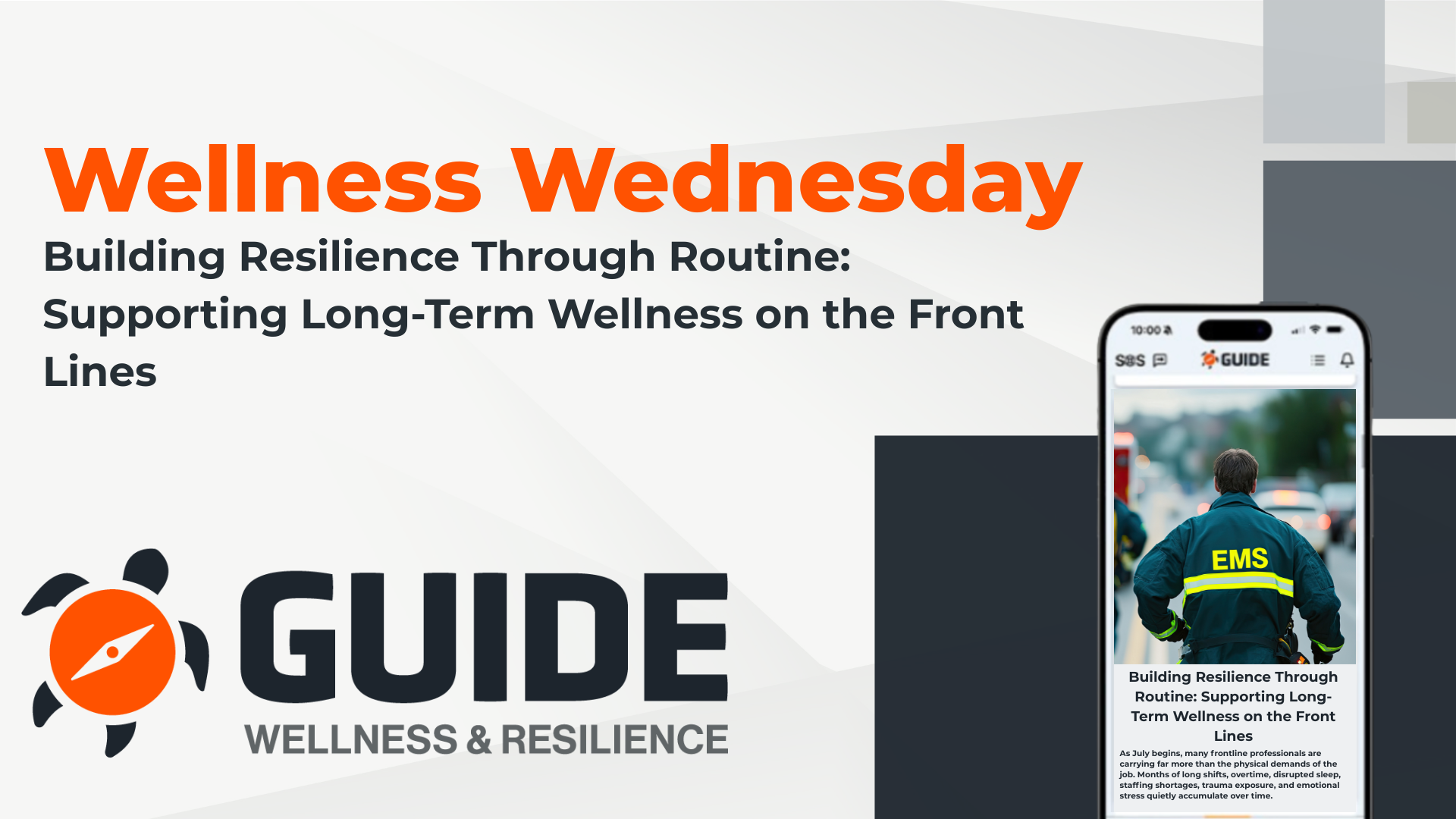

As National EMS Week kicks off on May 18th, the spotlight often falls on dramatic saves and high-speed responses. But at The GUIDE App, we know that the true story of EMS is written in the “in-between” moments: the heavy lifts, the transition from a chaotic scene back to the quiet of the station, and the mental weight of the lives you touch.
Being a medic is a unique discipline. It requires the strength of a powerlifter, the clinical mind of a doctor, and the emotional resilience of a counselor, all while moving at 60 miles per hour. This week, we are diving into the physical and mental architecture required to stay on the front line without breaking.
Part 1: The “Invisible Impact” of the Medic
The Chaotic Transition
For a paramedic or EMT, the “Invisible Impact” often occurs in the ten minutes after a high-acuity call. You’ve just spent forty minutes in a state of total Sympathetic Nervous System dominance, your heart is racing, your tunnel vision is sharp, and your brain is processing a thousand variables.
Then, you clear the hospital, get back in the rig, and… it’s quiet.
This rapid “downshift” is where the damage happens. If you don’t intentionally “decontaminate” your nervous system, you stay stuck in a state of “High Alert.” This leads to the classic EMS burnout: feeling wired but exhausted, losing patience with “low-code” patients, and eventually, the numbness of compassion fatigue.
The Tactical Reset: Before you even pull out of the hospital bay, take 60 seconds. Use Box Breathing (In 4, Hold 4, Out 4, Hold 4) to signal to your brain that the “threat” is over. This isn’t just “wellness”, it’s how you preserve your decision-making for the next call.
Part 2: Ready Strength: The “Lift & Load” Weekly Plan
Built for the Stretcher, Not Just the Gym
In EMS, your “field of play” is often a cramped bathroom, a narrow staircase, or a muddy ditch. Standard gym movements don’t always translate to the awkward, offset loads of patient extraction.
The Lift & Load Plan focuses on “Postural Integrity” and “Rotational Strength” to ensure your career isn’t cut short by a disc herniation. Here is your suggested physical movement plan for EMS Week:
The “Lift & Load” 3-Day Shift Cycle
This can be done at the station with minimal gear (Kettlebells/Dumbbells) or at a gym.
Day 1: Structural Integrity (The Heavy Lift)
- Zercher Squats: 4 Sets of 8 Reps. (Hold a barbell or sandbag in the crooks of your elbows). Why: Mimics the front-load demand of a stair chair.
- Suitcase Carries: 4 Sets of 40 yards (each side). Why: Builds the core stability needed to stay upright in a moving ambulance.
- Dead Hangs: 3 Sets to Failure. Why: Improves grip strength for long carries and decompresses the spine.
Day 2: Tactical Mobility (The Recovery Flow)
- 90/90 Hip Switches: 3 Minutes. Why: Opens up the hips that get tight from long hours of sitting in the rig.
- Cat-Cow to Bird-Dog: 3 Sets of 10. Why: Resets spinal alignment and engages the deep core.
- World’s Greatest Stretch: 5 Reps per side. Why: Hits thoracic mobility, crucial for reaching and lifting in tight spaces.
Day 3: The Extraction (Power & Stability)
- Single-Leg Romanian Deadlifts: 3 Sets of 10 per leg. Why: Teaches the body to stabilize while leaning over a patient.
- Half-Kneeling Overhead Press: 3 Sets of 12. Why: Mimics the shoulder stability needed when holding IV bags or reaching into high compartments.
- Farmer’s Walk (Heavy): 4 Sets of 50 yards. Why: The gold standard for total-body “patient load” conditioning.
Part 3: Compassion Fatigue vs. Tactical Empathy
How to Care Without Crashing
There is a myth in the first responder world that to be “tough,” you have to be “numb.”
Compassion Fatigue is what happens when you absorb the trauma of your patients until you have nothing left to give. You become cynical and detached.
Tactical Empathy, however, is a skill. It allows you to recognize a patient’s suffering, use that information to provide better care, but remain mentally separate from the tragedy.
Protecting Your Edge: Think of empathy like a piece of PPE. You put it on to do the job effectively, but you “doff” it (take it off) before you go home. Protecting your mental health isn’t “soft”; it’s what allows you to stay in this career for twenty years instead of five.
Part 4: The Performance Tool: Acknowledging Secondary Trauma
Why “The Weight” Isn’t a Weakness
In clinical circles, they call it Secondary Traumatic Stress (STS). In the bays, we just call it “the weight of the job.” It’s the cumulative effect of seeing things that “cannot be unseen.”
For a long time, acknowledging that a call “got to you” was seen as a weakness. We are changing that narrative. Acknowledging secondary trauma is actually a Performance Tool. Here’s why:
- Cognitive Load: When you suppress a traumatic memory, your brain uses a massive amount of energy to keep that “file” closed. That’s energy you can’t use for focus, reaction time, or patient care.
- The Decon Concept: Just as you wouldn’t leave blood on your uniform, you shouldn’t leave “mental blood” on your psyche. Talking through a call (Post-Action Stress Debrief) is simply “mental decon.”
The Bottom Line: Honor the Medic by Strengthening the Human
This EMS Week, we thank you for the lives you save. But we also want to challenge you to save your own life, too. By training for the specific physical demands of the rig and acknowledging the mental cost of the front line, you move from “surviving the shift” to thriving in the career.
Stay Strong. Stay Tactical. Stay Ready.